

EV battery testing spans several distinct goals: vehicle safety, pack performance, cell reliability, electromagnetic compatibility, and transport qualification. These goals use different requirements and test methods. Manufacturers and suppliers should identify the product level and applicable regulation first, then build a test plan around the vehicle category, pack design, and intended market.
Start with the applicable requirement
AIS-156 is an Indian automotive requirement for specified vehicle categories and includes requirements related to the safety of rechargeable electrical energy storage systems (REESS), including thermal propagation provisions in applicable versions. The exact requirements depend on the vehicle category and the applicable amendment. Confirm the current text and applicability with the relevant authority or approval agency before representing a test as mandatory.
IS 17855:2022 is a BIS standard for performance testing of lithium-ion traction battery packs and systems for electrically propelled road vehicles. BIS describes it as covering performance, reliability, and electrical functionality. It should not be described as a general battery safety certification or as a substitute for applicable vehicle regulations.
Keep cell, pack, vehicle, and transport testing distinct
A result at one level does not automatically demonstrate compliance at another. Cell tests characterise individual cells; pack tests assess an assembled battery system; vehicle-level requirements examine the installed system and its interactions. Transport requirements address hazards during shipment and are separate from vehicle approval.
IEC 62660-2 specifies reliability and abuse test procedures for lithium-ion cells and cell blocks used to propel electric road vehicles. UN Manual of Tests and Criteria subsection 38.3 concerns the design testing of lithium cells and batteries for transport. Neither should be presented as a blanket substitute for pack-level or vehicle-level approval testing.
Thermal and electrical validation
Thermal tests should match the requirement being evaluated. Thermal cycling can examine performance after repeated exposure to defined temperatures. Thermal propagation testing addresses how a design responds when a cell enters thermal runaway, where required by the applicable regulation or programme. It is a controlled safety evaluation conducted under defined procedures; avoid implying that one test alone guarantees a fire-proof battery.
Electrical testing may evaluate characteristics such as capacity, power, energy, and functionality under specified conditions. The relevant tests and acceptance limits depend on the standard, application, and pack architecture. Cell datasheets are useful inputs, but they do not by themselves establish performance or safety of the completed pack.
Mechanical and environmental exposure
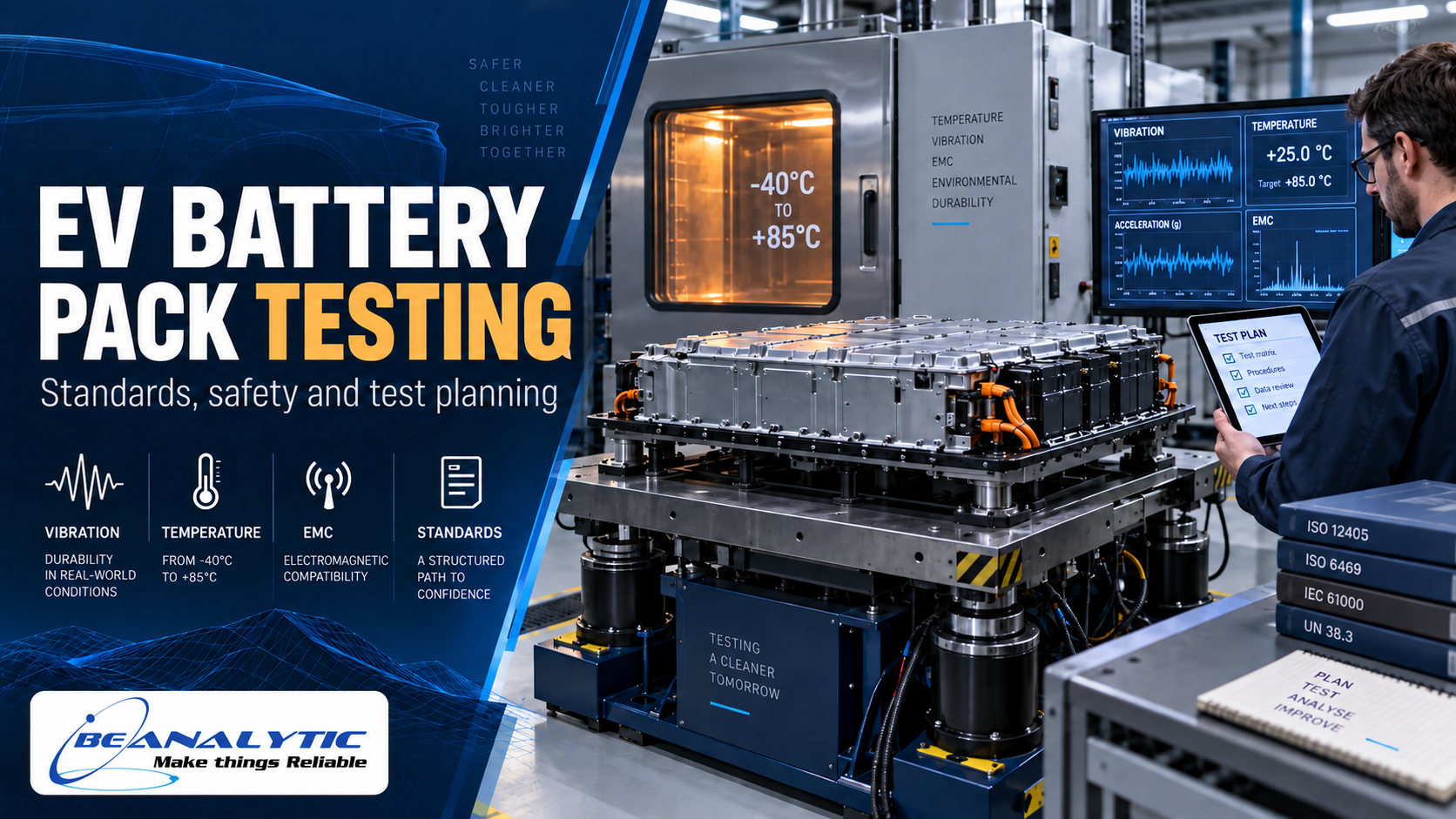
Vehicle batteries experience vibration and mechanical loads during operation. Testing to IEC 60068-2-6 provides a method for evaluating resistance to specified sinusoidal vibration; the method does not define one universal road profile or prove that a pack meets every automotive requirement. Select the vibration and shock conditions from the governing standard or an agreed engineering test plan, and document mounting, state of charge, monitoring, and post-test inspections.
Temperature, humidity, ingress, or altitude-related evaluations may also be relevant depending on the design and applicable programme. Include them only where a requirement or engineering rationale supports them, and specify the test level and pass criteria.
EMC testing for the battery system
Battery systems include high-current conductors and power electronics that can interact with vehicle electronics. Automotive EMC standards such as CISPR 25 and ISO 11452 address defined emissions and immunity evaluations for vehicle components and systems. They do not, on their own, demonstrate that a Battery Management System (BMS) will detect every overcharge or thermal event. EMC results should be considered alongside functional safety and system-level validation.
Work with a test plan matched to your product
BE Analytic can help EV teams translate requirements into a sequenced test plan. Start with the vehicle category, pack or component level, target market, applicable standard, and approval route. The team can then discuss specimen configuration, operating conditions, monitoring, test order, and the evidence expected from each test. Listed facilities include vibration and mechanical shock systems, thermal cycling and thermal shock chambers, humidity and altitude testing, ingress and drop testing, plus EMI/EMC capabilities. Reliability engineering support can help review failure modes and prioritise validation during product development.
This support can help teams find design or integration issues earlier and organise test evidence for review by the relevant OEM, approval agency, or certification body. A laboratory report supports that process; it does not itself confer vehicle approval or prove compliance beyond the tests and scope reported. Confirm that the battery pack, energy level, test method, safety arrangements, equipment limits, and requested accreditation scope are suitable before booking. Do not assume every vehicle battery safety or thermal propagation test is available at the facility.
Relevant facility details: https://www.beanalytic.com/environmental-reliability-testing/ | https://www.beanalytic.com/emi-and-emc-testing/
Contact BE Analytic to discuss your testing requirements: https://www.beanalytic.com/contact-us/
Sources and further reading
- BIS announcement describing IS 17855:2022: https://www.bis.gov.in/wp-content/uploads/2022/06/EVBatteries.pdf
- AIS-156 amendment published by ARAI: https://hmr.araiindia.com/api/AISFiles/AIS_156_with_Amd2_406992c5-3ef3-499f-a2f4-6677d5c7c7e9.pdf
- IEC 62660-2 cell and cell-block testing: https://webstore.iec.ch/en/publication/27387
- UNECE Manual of Tests and Criteria, Revision 8 and Amendment 1: https://unece.org/transport/dangerous-goods/rev8-files
- IEC 60068-2-6 sinusoidal vibration method: https://webstore.iec.ch/en/publication/544
- BE Analytic services: https://www.beanalytic.com/