



Automotive Reliability Engineering & Functional Safety Services
Why Reliability Matters for Automotive Products
A single field failure in an automotive component can trigger costly warranty claims, damage brand reputation, and in safety-critical applications, risk human lives. The automotive industry operates on razor-thin margins, and every returned product or recall campaign directly hits profitability.
Proactive reliability engineering — applied during design and development, not after production — identifies failure modes early, quantifies expected product life, and gives your engineering team the data they need to make informed design trade-offs. Companies that implement Design for Reliability (DFR) consistently achieve lower warranty costs, higher customer satisfaction, and faster time-to-market because they catch problems before tooling, not after launch.
Our Automotive Reliability Services
Design for Reliability (DFR)
DFR is a structured process that sets reliability targets at the concept stage and tracks them through every design milestone. We work alongside your design teams to define target MTBF values, identify critical components, run stress-strength analyses, and implement design improvements before prototyping. DFR prevents the expensive cycle of “build it, test it, fix it” by front-loading reliability decisions into the design phase.
MTBF Prediction and Warranty Modelling
We calculate Mean Time Between Failures (MTBF) for electronic, mechanical, and electromechanical automotive assemblies using established prediction standards such as MIL-HDBK-217, SN 29500, FIDES, and Telcordia SR-332. Beyond raw MTBF numbers, we build warranty cost models that help you set optimal warranty periods — periods that protect your customers without eroding your margins.
FMEA and FMECA for Automotive Components
Failure Mode and Effects Analysis (FMEA) is a contractual requirement for most automotive supply chains. We perform Design FMEA (DFMEA), Process FMEA (PFMEA), and Failure Mode Effects and Criticality Analysis (FMECA) following AIAG and VDA FMEA methodology. Our analysis identifies high-risk failure modes, assigns severity-occurrence-detection ratings, and recommends design or process changes ranked by Risk Priority Number (RPN).
Reliability Block Diagram (RBD) and System Modelling
For complex automotive systems — such as Battery Management Systems, ADAS controllers, or powertrain ECUs — we build Reliability Block Diagrams that model how component-level reliability translates to system-level performance. RBDs reveal where redundancy is effective, where single points of failure exist, and what the overall system MTBF will be under real-world operating conditions.
Accelerated Life Testing (ALT) and HALT
We design and execute Accelerated Life Tests (ALT) and Highly Accelerated Life Tests (HALT) to validate product reliability in a fraction of the time required by field testing. Our NABL accredited lab in Bengaluru supports environmental stress testing including temperature cycling, vibration, humidity, and combined stress profiles tailored to automotive operating conditions.
Learn more about our Environmental and Reliability Testing capabilities →
FRACAS — Failure Tracking and Corrective Action
A Failure Reporting, Analysis, and Corrective Action System (FRACAS) closes the loop between field failures and design improvements. We help automotive companies implement FRACAS processes that capture failure data, perform root cause analysis, track corrective actions, and feed lessons learned back into the DFR process for the next product generation.
Standards We Work With
Our automotive reliability work follows established industry and international standards including ISO 26262 (Functional Safety), IATF 16949 (Quality Management), AIAG/VDA FMEA Handbook, AEC-Q100/Q101/Q200 (Component Qualification), MIL-HDBK-217 and SN 29500 (Reliability Prediction), IEC 61508 (Functional Safety — general), and ISO 16750 (Environmental Testing for Road Vehicles).
Explore our full Reliability Engineering Service offerings →
Why Automotive Companies Choose BE Analytic
End-to-end capability. From MTBF prediction to HALT testing to ISO 26262 safety cases, we deliver the complete reliability and safety engineering package under one roof.
NABL accredited testing lab. Our Bangalore facility is NABL and DGAQA accredited, so your test reports are accepted by OEMs and regulatory bodies without additional validation.
Automotive domain expertise. Our engineers understand the specific failure modes, operating environments, and compliance frameworks relevant to automotive electronics, powertrain systems, body electronics, and EV components.
Cost-effective engineering. Our India-based team delivers the same engineering quality expected by European and North American OEMs, at significantly lower project costs.
Get a Free Reliability Assessment for Your Automotive Product →
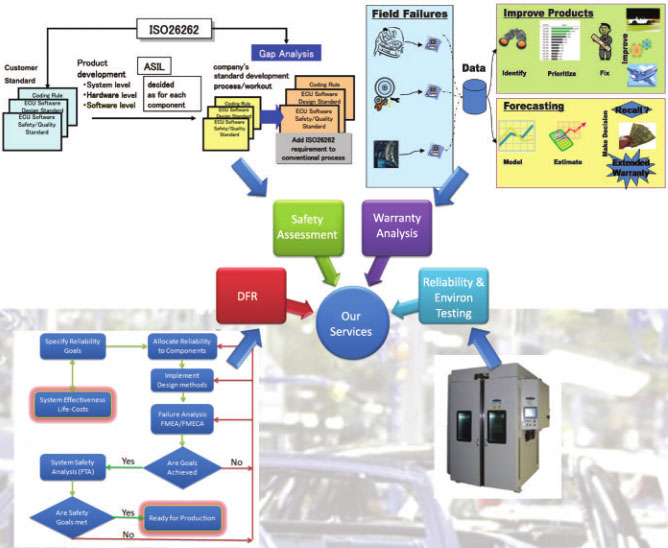
Our Services
Frequently Asked Questions
Everything you need to know about BE Analytic’s Automotive Reliability Engineering and Functional Safety Services.
DFR is an engineering methodology that embeds reliability targets into the product development process from the concept stage. Instead of discovering reliability problems during validation testing, DFR identifies and mitigates failure risks during design — reducing development cost and time-to-market.
ISO 26262 applies to safety-related electrical and electronic systems in production road vehicles. While not legally mandated in every jurisdiction, major automotive OEMs require ISO 26262 compliance from their suppliers as a contractual condition. Non-compliance effectively excludes suppliers from most automotive supply chains.
The duration depends on the system complexity and the number of components. A focused DFMEA for a single ECU with 50–100 components typically takes 3–5 weeks. A complete DFMEA and PFMEA program for a complex subsystem may span 2–4 months.
Yes. We provide both analytical services (MTBF, FMEA, FTA, RBD) and physical testing (temperature, vibration, humidity, ALT, HALT) from our NABL accredited laboratory in Bangalore. This integrated approach ensures consistency between predicted and validated reliability performance.