



Consumer Electronics and Appliances - High Reliability and Low Warranty Cost
Reliability Engineering Services for Consumer Electronics and Appliances
BE Analytic provides consumer electronics reliability testing and engineering services that cut warranty costs and protect brand reputation. Today’s consumer electronics market is intensely competitive — more companies, ever-rising customer expectations, and constant downward pressure on price. Every measure taken to reduce cost can introduce serious reliability problems if it is not managed carefully, and at the same time consumers expect products that simply work, day after day, for years. The only sustainable way forward is to deliver a genuinely reliable product, and that is where strong consumer electronics reliability engineering pays for itself.
The Business Case for Consumer Electronics Reliability
Reliability is not a cost centre — it is one of the highest-return investments a consumer electronics company can make. A reliable, trouble-free, robust product satisfies customers for the long term, earns positive reviews, drives repeat purchases, and reduces the single most painful line on the warranty ledger: returns.
Field failures are expensive in ways that go well beyond the cost of the replacement unit. They generate support calls, logistics costs, negative reviews, and lost future sales. A modest improvement in product reliability often produces a far larger improvement in profitability, because it removes those downstream costs entirely. This is why leading brands treat consumer electronics reliability as a competitive weapon, not a compliance chore.
Our Consumer Electronics Reliability Services
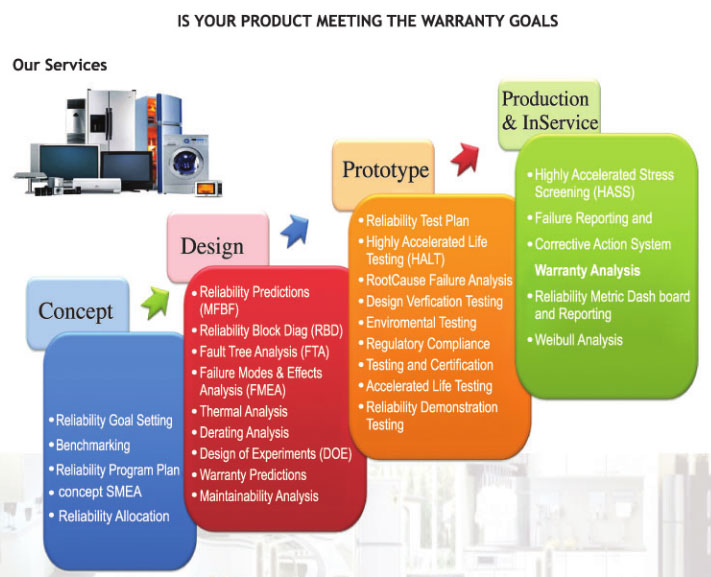
We offer the complete toolkit needed to design, predict, and validate consumer electronics reliability — from early analysis through accelerated testing in our NABL accredited laboratory.
Consumer Electronics Reliability Prediction and Warranty Modelling
- We calculate Mean Time Between Failures (MTBF) for electronic and electromechanical products and translate those figures into warranty cost models. This lets you set warranty periods that reassure customers without exposing the business to unexpected return costs, and it gives product managers a quantified basis for design and component decisions.
FMEA for Electronic and Electromechanical Products
- Failure Mode and Effects Analysis identifies how a product can fail, how serious each failure would be, and how likely it is to reach the customer. We perform Design and Process FMEA to surface high-risk failure modes early — while design changes are still inexpensive — and to prioritise improvements by risk.
Design for Reliability (DFR) and Robust Design
- DFR embeds reliability targets into the product from the concept stage and tracks them through development. Combined with robust design techniques, this approach reduces a product’s sensitivity to manufacturing variation, component tolerances, and real-world operating conditions, so it performs consistently across every unit shipped.
HALT, HASS, and Accelerated Stress Testing
- Highly Accelerated Life Testing (HALT) deliberately stresses a product beyond its specification to expose design weaknesses quickly, while Highly Accelerated Stress Screening (HASS) applies controlled stress in production to catch manufacturing defects before they ship. These techniques compress months of field experience into days and are among the most powerful tools for improving consumer electronics reliability.
Environmental Testing (Temperature, Humidity, Vibration, Drop, IP Rating)
Our NABL accredited laboratory in Bangalore performs the environmental tests consumer products must survive: temperature cycling, humidity, vibration, mechanical shock and drop testing, and ingress protection (IP) testing for dust and water resistance. We design test profiles that reflect how your product is actually shipped, handled, and used.
Explore our Environmental and Reliability Testing capabilities →
Reliability Growth and FRACAS
- We help you implement a Failure Reporting, Analysis, and Corrective Action System (FRACAS) to capture failures from testing and the field, perform root-cause analysis, and track corrective actions. Over successive design iterations this drives measurable reliability growth and continuously lowers warranty cost.
Today’s consumer electronics market has become highly competitive because of the increased number of companies and ever-increasing customer expectations. This competition causes dramatic cost decreases.
Every measure to reduce cost will lead to very crucial reliability problems if it is not managed well. Also, consumers’ expectations about the reliability of the products are increased. Reliable, trouble-free and robust products satisfy customer needs for a long time.
So, the way forward is only by offering a Reliable product to the customer.
Product Categories We Support
We support consumer electronics reliability across smartphones and tablets, wearables and fitness devices, IoT and smart-home products, audio and entertainment equipment, gaming accessories, power tools, and major and small home appliances such as washing machines, refrigerators, and air conditioners. Whatever the product, we tailor the reliability and testing program to its cost target, usage profile, and the operating environment it will face.
See how our EMI/EMC Testing supports consumer product compliance →
Frequently Asked Questions About Consumer Electronics & Appliances Reliability
Everything you need to know about HALT, MTBF, FMEA, and reliability testing for smartphones, home appliances, and electronics — covering IEC 60068, Telcordia SR-332, and warranty/returns optimization used by OEMs and brands globally
HALT applies escalating stress to rapidly expose design weaknesses that would otherwise take months of field use to appear. By revealing failure modes in days, it lets engineers fix problems before launch, shortening the overall development cycle and reducing late-stage surprises.
While it varies by product, the savings from reduced returns, support costs, and reputational damage usually far exceed the cost of the reliability program. Because field failures carry large hidden costs, even a small reliability improvement often yields a disproportionately large profit improvement.
Yes. We design test profiles to match specific retailer, platform, or OEM reliability and environmental requirements, and our NABL accredited reports are structured for acceptance by those partners.
Traditional reliability testing like MTBF or IEC 60068 verifies if a product meets spec under normal conditions. HALT, or Highly Accelerated Life Testing, finds design weaknesses fast by stressing products with extreme temperature, vibration, and voltage until they fail. For smartphones and appliances, HALT reduces development time 40-60% and cuts warranty returns by exposing failures before mass production.