


Railway RAMS & SIL Services
Railway RAMS & SIL Analysis Services
Railway projects demand more than compliance. They demand systems that are safe, reliable, maintainable, and ready for approval.
BE Analytic supports railway OEMs, system integrators, subsystem suppliers, operators, and project teams with end-to-end Railway RAMS and SIL engineering services. We help you plan, analyse, document, and demonstrate compliance for modern railway systems in line with applicable CENELEC and IEC standards.
From hazard analysis to safety case support, from reliability modelling to SIL-related activities, our team works across the full project lifecycle to help you reduce technical risk, improve confidence, and move faster toward customer and regulatory acceptance.
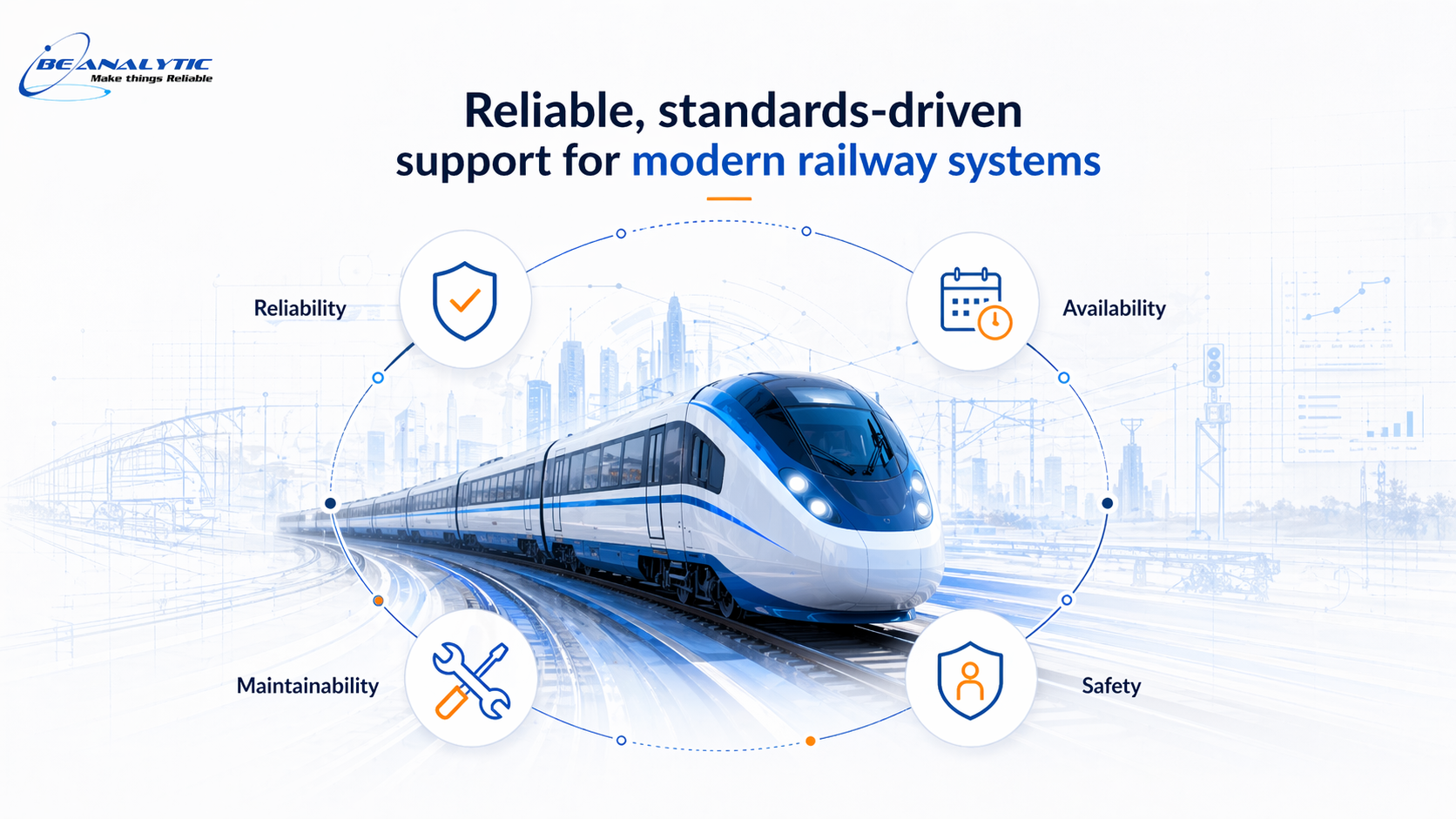
Reliable, standards-driven support for modern railway systems
As railway systems become more connected, software-driven, and safety-critical, the expectations on RAMS performance and safety justification continue to rise. Metro rail authorities, railway operators, infrastructure owners, and prime contractors increasingly require structured RAMS evidence, safety documentation, and standard-aligned engineering support before approving products and systems.
BE Analytic helps bridge that gap. We support clients with practical, engineering-focused RAMS and safety work that is technically sound, project-ready, and aligned with real delivery needs.
Our services are designed for teams working on:
- Signalling systems
- CBTC systems
- TCMS
- ATP and train protection functions
- PSD systems
- TVS and traction-related systems
- ECS and tunnel ventilation interfaces
- Rolling stock and onboard systems
- Power supply and related subsystems
- SCADA and integrated railway infrastructure systems
Our Railway RAMS & SIL capabilities
RAMS planning and programme support
A strong railway RAMS programme begins with a clear structure. We help define the RAMS approach, scope, assumptions, responsibilities, targets, and evidence framework needed for the project.
Our support includes:
- RAMS programme planning
- RAMS management plan preparation
- Requirement allocation and apportionment
- Reliability target setting
- Maintainability and availability planning
- Supplier RAMS coordination
- Review support for customer submissions
Hazard analysis and risk assessment
Hazard identification and risk control are central to railway safety engineering. We support structured analysis that helps teams identify credible hazards, understand system-level risk, and define robust mitigation strategies.
Typical activities include:
- Preliminary Hazard Analysis
- System Hazard Analysis
- Subsystem Hazard Analysis
- Interface Hazard Analysis
- Hazard Log support
- FMEA / FMECA
- Fault Tree Analysis
- Risk ranking and mitigation tracking
- Verification of hazard closure evidence
Safety case and compliance support
A safety case should do more than collect documents. It should present a clear and defensible argument that the system is safe for its intended use.
We support clients in preparing and strengthening safety case documentation for railway projects by aligning technical evidence, assumptions, risk controls, and verification outcomes into a coherent compliance story.
Our support includes:
- Safety case structure development
- Safety argument support
- Evidence mapping
- Assumption and dependency tracking
- Verification and validation linkage
- Compliance matrix preparation
- Independent review support
- Presentation support for project authorities and customer review teams
Our support includes:
- RAMS programme planning
- RAMS management plan preparation
- Requirement allocation and apportionment
- Reliability target setting
- Maintainability and availability planning
- Supplier RAMS coordination
- Review support for customer submissions
SIL support for railway applications
Safety Integrity Level related activities require clear interpretation of system functions, risk impact, architecture constraints, and standard expectations. We help teams define the right path and produce practical engineering outputs that support decision-making.
Our SIL-related support includes:
- SIL interpretation support
- SIL allocation guidance
- Safety function analysis
- Architecture review support
- Verification and validation planning
- Safety requirement tracing
- Documentation support linked to EN 50126, EN 50128, EN 50129 and IEC 61508 where applicable
Typical activities include:
- Preliminary Hazard Analysis
- System Hazard Analysis
- Subsystem Hazard Analysis
- Interface Hazard Analysis
- Hazard Log support
- FMEA / FMECA
- Fault Tree Analysis
- Risk ranking and mitigation tracking
- Verification of hazard closure evidence
Reliability, availability and maintainability analysis
RAMS performance is not only about safety. It is also about service continuity, maintainability, and lifecycle performance.
We support detailed engineering studies such as:
- MTBF prediction
- MTTR estimation
- Reliability Block Diagram analysis
- Availability modelling
- Reliability apportionment
- Failure mode studies
- Maintainability-focused engineering review
- Support for subsystem-level and system-level RAMS targets
Standards expertise
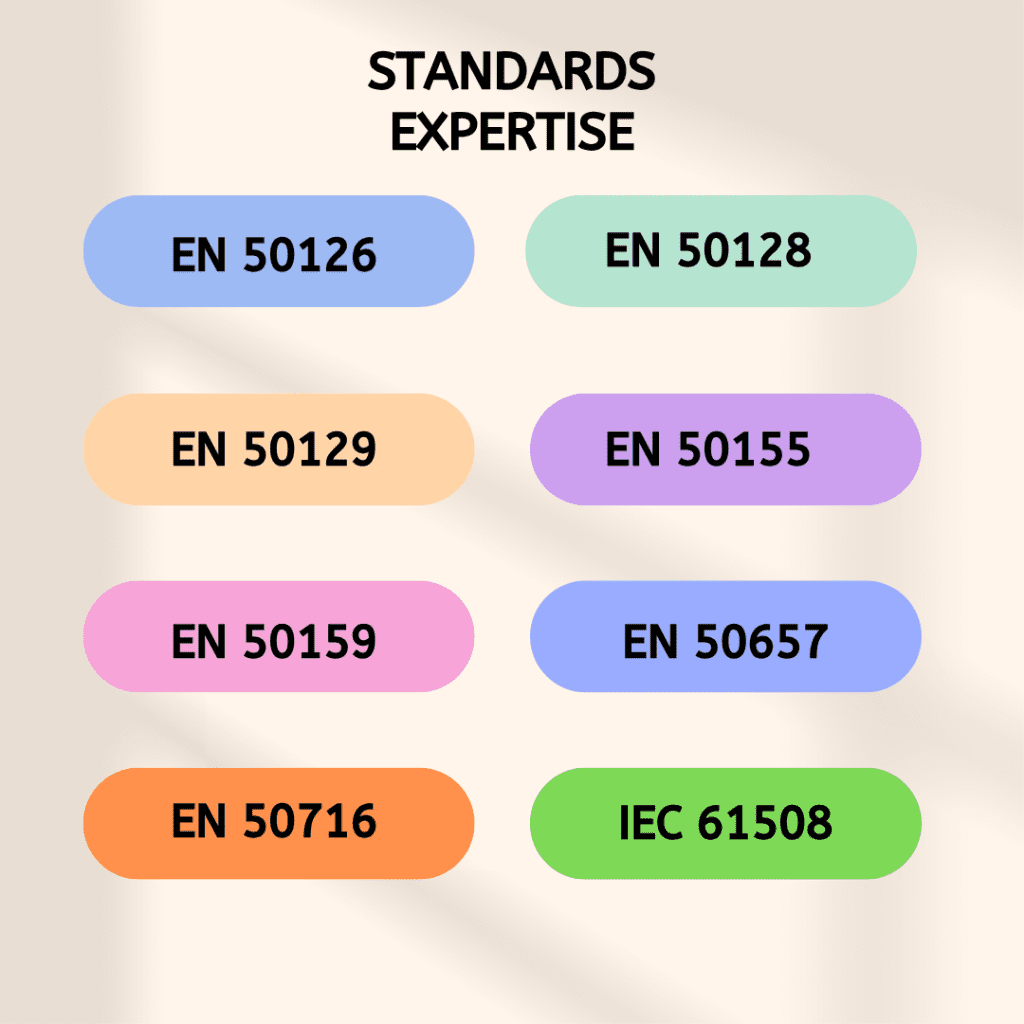
Our railway RAMS and SIL services are aligned to relevant international and railway-domain standards, based on project scope and applicability.
We support work aligned to:
- EN 50126
- EN 50128
- EN 50129
- EN 50155
- EN 50159
- EN 50657
- EN 50716
- IEC 61508
Where needed, we help clients interpret how these standards affect product development, software assurance, safety justification, subsystem integration, and approval readiness.
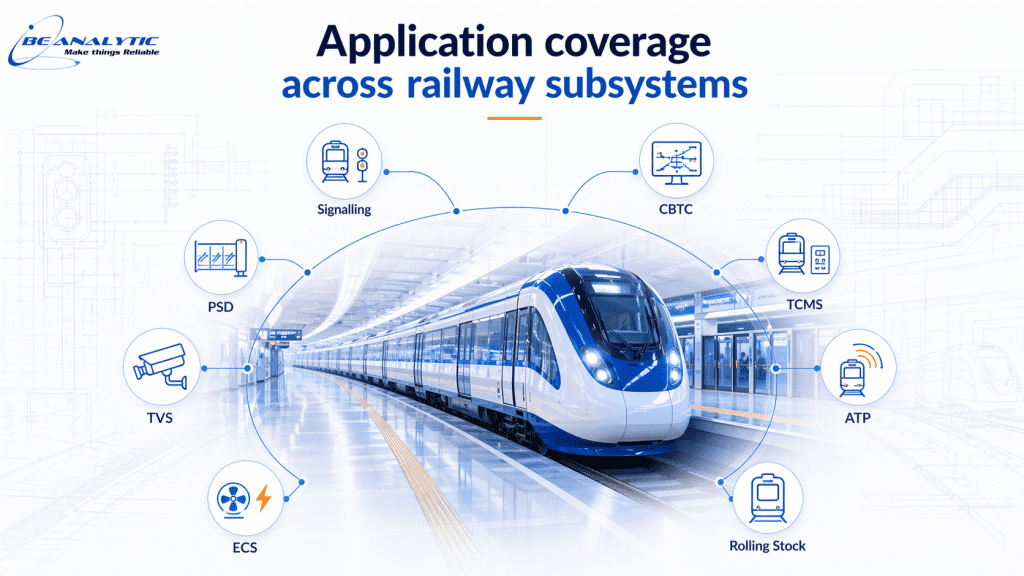
Application coverage across railway subsystems
Railway systems are highly interconnected. A weakness in one subsystem can affect safety, reliability, integration, or project acceptance elsewhere. That is why our work is not limited to a single box or document set.
We support RAMS and safety activities across a wide range of railway applications, including:
-
Signalling : Support for hazard analysis, system interfaces, safety requirements, and compliance-linked documentation for signalling environments.
-
CBTC : Support for RAMS planning, safety evidence structure, risk review, and subsystem interface understanding for communication-based train control systems.
-
TCMS : Support for reliability, functional interaction review, safety-related analysis input, and maintainability-oriented engineering studies.
-
ATP : Support for safety-critical function review, hazard analysis input, and risk-based engineering evidence.
-
PSD : Support for safety and reliability analysis of platform screen door systems and their interfaces with signalling and rolling stock.
-
TVS and traction-related systems : Support for subsystem-level RAMS studies and project integration understanding.
-
ECS : Support for railway environmental control related RAMS activities and system interaction assessment.
-
Rolling stock : Support for onboard subsystem RAMS, maintainability, safety documentation, and allocation-based studies.
We combine reliability engineering depth with practical project understanding. Our goal is not to produce paperwork for its own sake. Our goal is to help your team create useful, review-ready engineering outputs that support approvals, reduce uncertainty, and improve project delivery confidence.
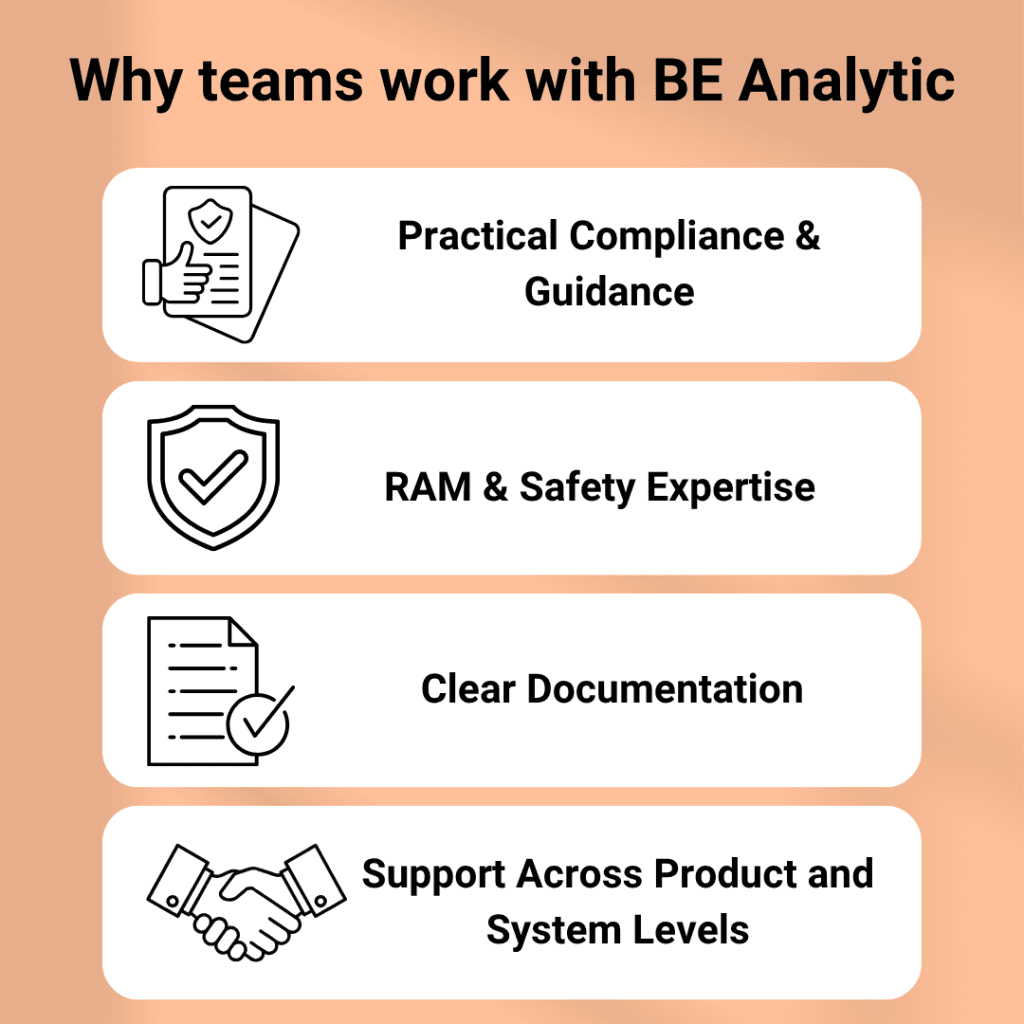
Clients choose us because we offer:
- Practical and compliance-focused guidance
- Strong grounding in RAMS and safety engineering
- Support across both product and system levels
- Experience working with multidisciplinary project teams
- Clear, usable documentation
- Flexible support for OEMs, integrators, suppliers, and project owners
Frequently Asked Questions About Railway RAMS & SIL Services
RAMS stands for Reliability, Availability, Maintainability, and Safety. In railway engineering, RAMS is a systematic process defined by EN 50126 for specifying, predicting, and demonstrating the dependability and safety performance of railway systems and subsystems. It applies across the full system lifecycle — from concept through decommissioning.
Safety Integrity Level (SIL) is a measure of the required reliability of a safety function. SIL ranges from SIL 0 (no specific safety requirement) to SIL 4 (the highest integrity level, typically required for signalling safety functions). SIL determines the rigour of the design, testing, and documentation processes that must be followed. Without a proper SIL assessment, your system cannot receive safety approval.
The primary standards are EN 50126 (RAMS lifecycle), EN 50129 (safety-related electronic systems), and EN 50716 (software for railway applications, which replaced EN 50128 in 2023). IEC 61508 provides the overarching functional safety framework. Indian metro rail projects typically require compliance with these CENELEC standards as part of their tender specifications.
A comprehensive RAMS study typically includes MTBF prediction, Reliability Block Diagram (RBD) modelling, FMEA or FMECA, Fault Tree Analysis (FTA), Preliminary Hazard Analysis (PHA), SIL allocation, availability and maintainability modelling, and safety case development. The exact scope depends on the subsystem, the applicable SIL, and the project owner’s requirements.
The timeline depends on the scope and complexity of the subsystem. A focused work package — such as MTBF prediction and FMECA for a single subsystem — can be completed in 4 to 8 weeks. A full RAMS program covering multiple subsystems from program plan to safety case submission may span 6 to 18 months, aligned with the overall project schedule.
Yes. While our engineering team is based in Bengaluru, we support railway projects globally. We work remotely with international clients and can participate in on-site reviews, safety presentations, and ISA meetings as required.
EN 50716 was published in 2023 and superseded both EN 50128 (software for signalling) and EN 50657 (software for rolling stock). It merges the two into a single unified software standard and introduces cybersecurity considerations. Projects initiated before 2023 may still reference EN 50128, but new projects should align with EN 50716.