

Your product works perfectly on the test bench. You power it up next to another device — and everything fails.
This is not a design flaw. It is not a manufacturing defect. It is an electromagnetic compatibility problem. And it is one of the most common — and most preventable — causes of product certification failure, field malfunction, and costly recalls in electronics development.
This guide covers everything you need to know about EMI and EMC testing: what it is, how it works, which standards apply to your product, and how to approach compliance without wasting time or budget.
1. What Is EMI and EMC Testing?
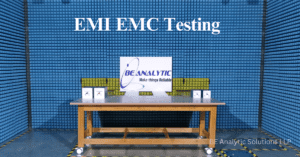
EMI and EMC testing is the process of evaluating an electronic product’s electromagnetic behaviour — both what it emits and how it responds to electromagnetic energy from its environment.
EMI testing — Electromagnetic Interference testing — measures the unwanted electromagnetic energy a device generates and verifies it remains within regulatory limits.
EMC testing — Electromagnetic Compatibility testing — is the broader evaluation confirming that a device can operate correctly in its intended electromagnetic environment without disrupting other nearby equipment.
Together, EMI and EMC testing form the mandatory compliance gateway for virtually every electronic product entering the defence, automotive, aerospace, medical, industrial, and consumer markets.
Without passing EMC testing, a product cannot receive regulatory approval. It cannot be deployed in defence systems. It cannot enter automotive supply chains. It cannot be sold in regulated markets.
2. EMI vs EMC — Understanding the Core Distinction
These two terms are often used interchangeably — incorrectly.
EMI (Electromagnetic Interference) refers to the electromagnetic disturbance itself. It is the unwanted energy that a device generates and either radiates through the air or conducts through its cables. EMI is the problem.
EMC (Electromagnetic Compatibility) is the engineering discipline and compliance framework that ensures devices do not cause unacceptable EMI and can withstand EMI from other sources. EMC is the solution.
An EMI test measures whether your device is a source of interference. An EMC test programme evaluates both — whether your device causes problems and whether it can survive the electromagnetic environment it will operate in.
Every complete EMC programme consists of two independent evaluation streams: Emissions and Immunity.
3. The Two Sides of EMC: Emissions and Immunity
Emissions Testing
Emissions testing verifies that the electromagnetic energy your device generates — both radiated through the air and conducted through its cables — does not exceed the regulatory limits for your product category and target market.
A product that exceeds emissions limits will interfere with other devices in the same environment. This is why emissions limits exist: to ensure that the electromagnetic environment remains usable for every product operating within it.
Immunity Testing
Immunity testing — also called susceptibility testing — verifies that your device continues to perform correctly when subjected to electromagnetic interference from external sources.
This side of the programme is where many development teams under-invest. A product can pass all emissions tests and still fail immunity testing on the same test day. Both sides carry equal regulatory weight. Failing either means the product does not achieve EMC compliance.
4. Types of EMI Testing
Radiated Emissions Testing
Radiated emissions testing measures the electromagnetic energy that propagates through the air from a device and its cables during normal operation.
How it is done: The device under test (DUT) operates in an anechoic or semi-anechoic chamber. A calibrated receive antenna connected to a spectrum analyser measures the field strength at specified distances and across specified frequency ranges.
Frequency range: Typically 30 MHz to 1 GHz for commercial products, extending to 18 GHz for MIL-STD-461 RE102 and up to 6 GHz for automotive CISPR 25.
Typical root causes of failure:
- Poor PCB shielding and layout
- Clock harmonics radiating from unshielded traces
- Cables acting as unintentional antennas
- Inadequate enclosure RF bonding
Conducted Emissions Testing
Conducted emissions testing measures the electromagnetic noise that travels along the power supply and signal cables connected to the device — back into the mains supply or to connected equipment.
How it is done: A Line Impedance Stabilisation Network (LISN) is connected at the power input of the device. The LISN presents a defined impedance to the device’s power port and allows measurement of noise voltage on the supply lines.
Frequency range: Typically 150 kHz to 30 MHz for commercial products (IEC 61000-3). MIL-STD-461 CE102 covers 10 kHz to 10 MHz; CE101 covers 30 Hz to 10 kHz.
Typical root causes of failure:
- Switching power supply noise
- Inadequate EMI input filter design
- Poor grounding and bonding topology
- Common mode noise on signal cables
Transient EMI Testing
Transient EMI testing evaluates a device’s ability to withstand sudden changes in voltage or current — such as those caused by power surges, lightning strikes, or load switching events in a vehicle electrical system.
Magnetic EMI Testing
Magnetic EMI testing assesses the magnetic fields emitted by a device and verifies they do not exceed limits that could affect nearby magnetically-sensitive equipment.
5. Types of EMC Immunity Testing
Radiated Immunity Testing (Radiated Susceptibility)
Radiated immunity testing exposes the device under test to controlled levels of RF electromagnetic fields to confirm it continues to function correctly.
MIL-STD-461 RS103 tests radiated immunity to electric fields from 2 MHz to 40 GHz — far exceeding commercial standards (which typically stop at 6 GHz) because defence systems operate near radar transmitters, electronic warfare equipment, and other high-power RF sources.
IEC 61000-4-3 covers commercial and industrial products from 80 MHz to 6 GHz.
Conducted Immunity Testing (Conducted Susceptibility)
Conducted immunity testing injects electromagnetic noise onto the power and signal cables of the device to evaluate how well it performs under conducted interference conditions.
MIL-STD-461 CS114 uses bulk cable injection (BCI) to inject RF current onto cable bundles from 10 kHz to 200 MHz. This replicates the interference that defence equipment cables experience in real electromagnetic environments.
IEC 61000-4-6 covers conducted RF immunity for commercial products from 150 kHz to 80 MHz.
ESD Immunity Testing
Electrostatic discharge testing evaluates the device’s ability to withstand the rapid discharge of static electricity — such as occurs when a person touches the device during assembly, handling, or service.
Governed by IEC 61000-4-2 for commercial and industrial products, and CS118 under MIL-STD-461 for defence.
Electrical Fast Transient and Surge Immunity
IEC 61000-4-4 (fast transient/burst) and IEC 61000-4-5 (surge) test the device’s immunity to the kind of sharp electrical transients that occur in industrial power environments during switching events, relay operation, and fault conditions.
MIL-STD-461 CS116 covers damped sinusoidal transients on cables and power leads from 10 kHz to 100 MHz.
6. EMC Standards by Industry
| Industry | Primary Standard | Key Tests |
|---|---|---|
| Defence | MIL-STD-461 | CE, CS, RE, RS — 11 test requirements |
| Automotive | CISPR 25, ISO 11452 | Radiated/conducted emissions, BCI, ESD |
| Aerospace | DO-160 (RTCA) | RF, lightning, voltage spikes, magnetic |
| Industrial | IEC 61000 series | Emissions, ESD, surge, burst, conducted RF |
| Commercial | EN 55032, EN 55035 | Radiated/conducted emissions and immunity |
| Medical | IEC 60601-1-2 | EMC for medical electrical equipment |
| Railway | EN 50121 series | Railway EMC requirements |
7. EMI/EMC Testing at BE Analytic Solutions LLP
BE Analytic Solutions LLP operates a full-capability EMI/EMC testing laboratory in Bengaluru, India. The laboratory is NABL accredited to ISO 17025 — India’s national accreditation benchmark for testing and calibration laboratories.
Standards We Test To
Defence: MIL-STD-461 (CE101, CE102, CS101, CS114, CS115, CS116, CS118, RE101, RE102, RS101, RS103)
Automotive: CISPR 25 · ISO 11452-2 · ISO 11452-4 (BCI) · ISO 7637-2 · ISO 10605-2008 · ISO 16750-2
Aerospace: RTCA DO-160 (Magnetic Effects, Power Input, Voltage Spikes, RF Susceptibility, RF Emissions, Lightning, ESD)
Commercial and Industrial: IEC 61000-4-2 · IEC 61000-4-3 · IEC 61000-4-4 · IEC 61000-4-5 · IEC 61000-4-6 · IEC 61000-4-8 · IEC 61000-4-11 · CISPR 11 · CISPR 15 · CISPR 32
Other: EN 50081-2 · EN 50082-2 · EN 50121 series · 89/336/EEC
Test Capabilities
- Radiated EMI Testing
- Conducted EMI Testing
- Transient EMI Testing
- Magnetic EMI Testing
- Radiated Emissions Testing
- Conducted Emissions Testing
- Radiated Immunity (Susceptibility) Testing
- Conducted Immunity (Susceptibility) Testing
- ESD Testing
- Transient and Surge Immunity Testing
Contact BE Analytic Solutions LLP
📞 Phone: +91 8095000439
📧 Email: sales@beanalytic.com
🌐 Website: www.beanalytic.com/emi-and-emc-testing/
📍 Address: B131/A, Devasandra Industrial Estate,
Mahadevapura, Bengaluru — 560048, Karnataka, India