


Energy and Petrochemicals - RAMS
RAMS and SIL Assessment Services for Energy and Petrochemical Industries
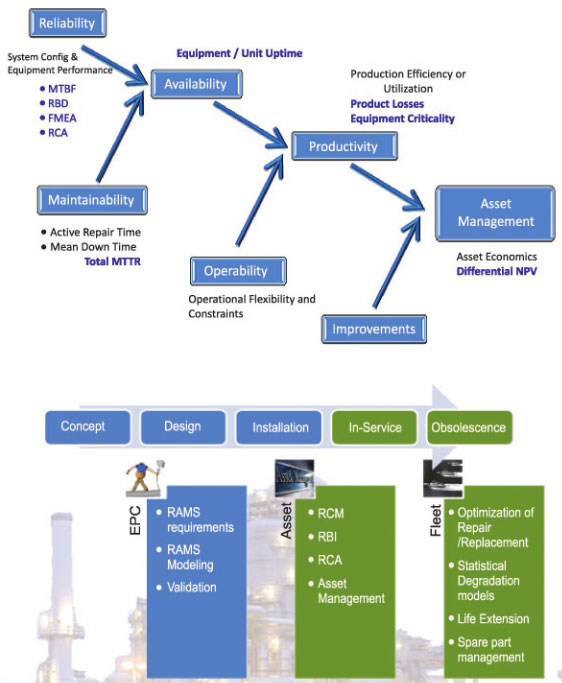
BE Analytic provides energy and petrochemical RAMS services that pinpoint the equipment and systems causing production losses, then quantify their financial impact so you can act on them. Our petrochemical RAMS studies run from the EPC (Engineering, Procurement, and Construction) stage all the way through to plant obsolescence. The objective is straightforward: identify the assets, operations, or systems responsible for lost production, measure the cost of those losses, and select the optimum mix of equipment configuration, sparing strategy, and maintenance regime to maximise output at the lowest sustainable cost.
We develop Reliability Block Diagrams, calculate availability and reliability factors, prioritise assets by their impact on production, and carry out sensitivity analysis so you know exactly where to invest for the greatest return.
Why Petrochemical RAMS Studies Protect Production
In the energy and petrochemical sector, unplanned downtime is enormously expensive. A single day of lost production at a refinery or LNG terminal can cost millions, and safety incidents carry consequences far beyond financial loss. A well-executed petrochemical RAMS study turns reliability from an abstract concern into a quantified, prioritised action plan.
Rather than treating every asset equally, RAMS analysis reveals which components actually limit production availability and which safety functions truly protect personnel and the environment. This lets operators direct maintenance budgets, spare-parts inventory, and capital upgrades where they deliver measurable improvements in availability and safety — instead of spreading resources thinly across equipment that has little impact on the bottom line.
Our Petrochemical RAMS Services
We deliver the full range of reliability, availability, maintainability, and safety analyses required across the energy and petrochemical lifecycle.
RAM Study and Production Availability Modelling
- We build production availability models that simulate how equipment failures, maintenance activities, and sparing strategies affect overall plant output. Using Reliability Block Diagrams and Monte Carlo simulation where appropriate, we calculate system availability, identify production bottlenecks, and quantify the throughput impact of different design and operating choices.
SIL Determination and SIL Verification (IEC 61508 / IEC 61511)
- Safety Integrity Level (SIL) work has two distinct phases. SIL determination establishes how much risk reduction a safety function must provide, typically using HAZOP findings combined with Layer of Protection Analysis (LOPA) or risk graphs. SIL verification then proves, through calculation, that the as-designed Safety Instrumented System actually achieves the required SIL. We perform both, following IEC 61508 (the general functional safety standard) and IEC 61511 (the process-industry sector standard).
Petrochemical RAMS and MTBF Prediction with Spare Parts Optimisation
- We predict Mean Time Between Failures for critical equipment and use those figures to optimise spare-parts holdings. Holding too few spares risks extended downtime; holding too many ties up capital. Our analysis finds the balance, recommending sparing levels that meet your availability targets at the lowest inventory cost.
Reliability Block Diagram (RBD) and Sensitivity Analysis
- We model the plant as a network of reliability blocks to understand how individual equipment reliability rolls up into system availability. Sensitivity analysis then shows which components have the greatest influence on overall performance, so improvement efforts are focused where they matter most.
Standards We Apply
Our energy and petrochemical RAMS work follows IEC 61508 (Functional Safety of E/E/PE Systems), IEC 61511 (Functional Safety for the Process Industry), and recognised industry practices for RAM modelling, FMEDA, and Reliability Centred Maintenance. We align our deliverables with the expectations of EPC contractors, operators, and independent verification bodies.
Applications We Support
We deliver petrochemical RAMS services for oil and gas refineries, offshore platforms and FPSOs, LNG terminals, power generation plants, renewable energy systems, pipeline infrastructure, and chemical processing facilities. Our support spans the full lifecycle — from RAM targets set during front-end engineering design to SIL verification before commissioning and RCM optimisation during operation.
Our RAMS services for the Energy and Petro Chemical industry start from the EPC stage to obsolescence. RAMS study is done with the objective of identifying the equipment, operations or systems that cause production losses, quantifying the impact of these losses and selecting the optimum equipment, configurations, spares requirements, operations and maintenance strategy to maximize production at optimum cost. We develop Reliability Block Diagrams, calculate availability and reliability factors prioritize assets based on their impact and carry out sensitivity analysis.
Frequently Asked Questions About Energy & Petrochemicals
Everything you need to know about RAM, SIL, and safety analysis for energy and petrochemical facilities — covering IEC 61511, IEC 61508, and reliability modeling used by EPCs and operators globally
SIL determination decides how much risk reduction a safety function needs (the target SIL), usually from HAZOP and LOPA. SIL verification proves by calculation that the installed system actually delivers that target, using FMEDA data and a PFDavg calculation. You need both: one sets the requirement, the other confirms it is met.
A RAM study identifies which specific equipment limits production availability and quantifies the impact of each failure mode. This lets you target maintenance, redundancy, and sparing at the true bottlenecks, raising availability more effectively than untargeted spending.
Ideally at the EPC or front-end engineering design stage, when reliability and availability targets can still influence the design. Starting early is far cheaper than retrofitting reliability into an operating plant.
LOPA, or Layer of Protection Analysis, is the method used to calculate the required SIL level for a Safety Instrumented Function. SIL determination sets the target risk reduction. LOPA quantifies initiating events, independent protection layers, and consequence severity to assign SIL 1, 2, 3, or 4. ITEM QT supports both LOPA workflows and automatic SIL verification.